
Using a Somatic Lens
A mentorship program offered to those who have a counselling, social work, massage, physical therapy or psychology destination
Using A Somatic Lens is a mentorship program with an experiential and informational component that offers the latest information in somatic intervention for counselling.
Prerequisites
- A counselling, social work, massage therapy, physical therapy or psychology designation
- Completion of Lowering Anxiety through Self-Regulation training
- 2 personal somatic sessions with Lois
Using A Somatic Lens Format
Within each mentoring counselling session, the somatic perspective is defined, implemented, and then discussed using question and answers.
Other theories implemented are:
attachment theory; the study of relationship, bonding and its disruption, human development theory, Stephen Porges’ polyvagal theory; internal family systems theory; integrating inner child work when appropriate, as well as the neurophysiological impact of traumatic stress, current traumatic stress research, including brain plasticity.
These theories are combined to offer a highly individualized and most effective intervention session for each client.
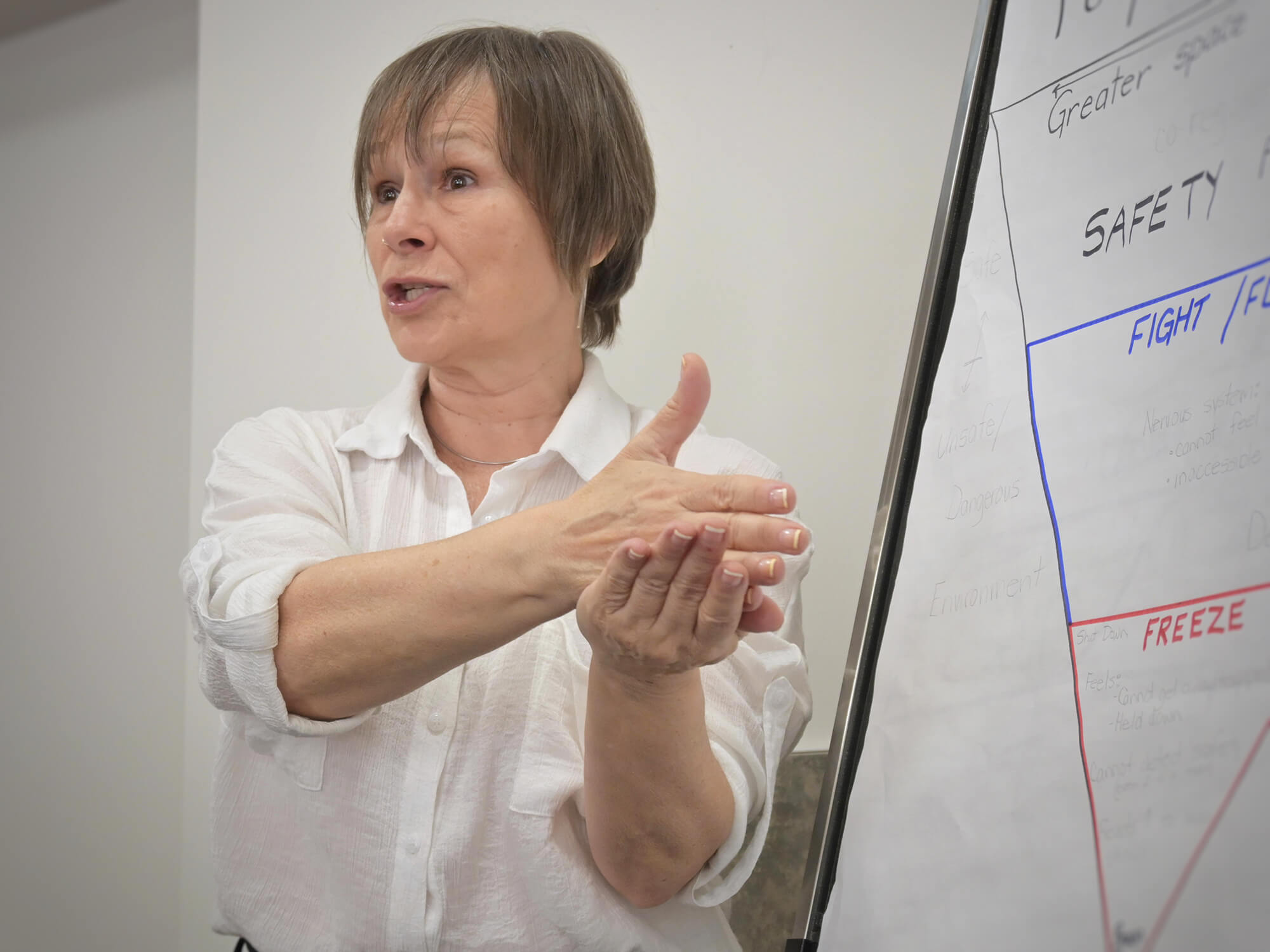
4 sessions per module
Sessions are offered every other month, in two hour sessions:
A somatic intervention is presented, modelled, and discussed, comparing how the somatic approach in this situation is different.
Participants practice applying the process on each other, while the mentor encourages talks, guides and gives feedback.
- Sessions offered online
- Three participants per module
- Cost is $200 per hour and each session is two hours
Lois Agrey, MEd, Somatic Experiencing® Practitioner
Lois, the facilitator, is fully trained in somatic experiencing therapy, strength-based therapy, play therapy, family systems therapy, Gottman couples therapy, mindfulness training, human sexuality, touch therapy, and in the school of hard knocks. Somatic experiencing is the strongest influence in her counselling sessions. She is also fully trained in cognitive behavioural therapy, using techniques such as cognitive restructuring, covert modelling, systematic desensitization, problem-solving, and guided imagery or visualization when appropriate.
Her work experience includes:
- 28 years: Private practise
- 15 years: Facilitating a court-ordered 13 week group for men charged with intimate partner violence
- 3 years: Facilitating an FNHA sponsored 3 week program for Aboriginal leaders
- 16 years: Assisting in training Somatic Experiencing Program
- 10 years: Assisting in training therapists Somatic Touch Training
- 8 years: Elementary school counsellor
Her specialized training and experience in trauma include:
- Working with shock trauma, a one-time or just a few traumatic experiences
- Developmental trauma, traumas experienced as a child, teenager, and or younger adults
- Intergenerational trauma, trauma that siblings, parents, uncles and aunts, grandparents, and ancestors may have experienced
- Complex trauma, any or all of the previous mentioned traumas
Trauma Theory
When people experience something overwhelming such as an assault, a car accident, childhood neglect or abuse they often don’t leave the effects of that experience when it is over. Trauma is far-reaching and energetic in nature. Effects of the traumatic events can wreak havoc in a person’s life many years after the traumatic event is over. Not only does it affect the person who experiences the event, but it also affects their families and communities.
Our central nervous system activates and deactivates in response to our outer sensory input or inner input. The comfortable area within our central nervous system, Dr. Dan Seigal identified and named our window of tolerance. Everyone’s window of tolerance is as unique as their fingerprints. When the activation from stimuli, whether outer and inner, stay within our window of tolerance we are our best selves. This is called regulation. Once we are pushed beyond our window of tolerance there is a natural process of activation that often feels like fear, anxiety, anger, or just a numbness. If continued to be pushed out of our window of tolerance often fear turns to terror or rage or even a robotic feeling. These are powerful experiences and can have a significant impact for many years.
A Somatic Approach to Trauma Recovery
Sometimes our experiences were too difficult or went on for too long and our nervous system was either too young or simply unable to accommodate the higher activation level that was experienced. What results is an incompletion of undischarged trauma energy in our system and we somehow feel different. Because the energy was not able to complete the cycle, the undischarged energy is still in the body, needing to be released. Building capacity in the body, as well as applying specialized somatic assistance can be helpful in releasing undischarged energy resulting from these times. This is done through freeing the body from such powerful negative bodily or emotional responses.
Some people call this application neurophysiological. It is good to see that the understanding and application of neurophysiological impact of traumatic stress is now starting to create an impact in our society. ‘Using A Somatic Lens’ applies this approach in a practical and applicable way to help trauma to be released and to promote long term sustainable change.
Bringing a Somatic Lens Into Practice
Prerequisites
- A counselling, social work, massage therapy, physical therapy or psychology designation
- Completion of Lowering Anxiety through Self-Regulation training
- 2 personal somatic sessions with Lois
Contact to find out when the next Using a Somatic Lens module will be available:
Phone: (250) 487-0236
Email: lois.lcpc@gmail.com